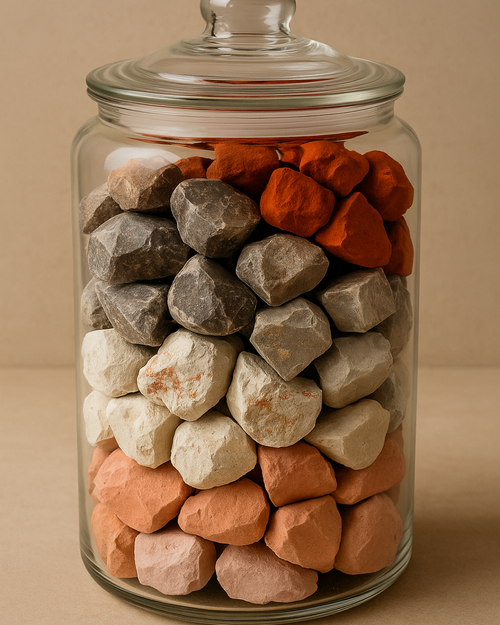

If you’ve ever delved into the world of edible clays, you’ll know there’s more than meets the eye—both in flavour and texture. Among these, Mexican clays are a fascinating family, celebrated for their variety of forms, crunch profiles, and subtle, earthy aromas. Let’s explore the spectrum of Mexican clays, what they taste like, how they feel on your teeth, and where in the world you might find them.
1. Caolins
Texture & Crunch: Silky smooth with a very fine, almost powdery bite. Gentle on the teeth but still satisfying when chewed.
Taste: Mildly sweet with soft mineral undertones, hints of chalk, and faint porcelain-like notes.
Regions Found: Southern Mexico, particularly Veracruz and Puebla, where kaolin deposits are abundant.
2. Terrones
Texture & Crunch: Firm and chunky, breaks with a robust snap; slightly grainy.
Taste: Earthy and rich, reminiscent of topsoil after rain, with subtle smokiness and mineral depth.
Regions Found: Central and northern Mexico, often in clay-rich riverbeds and hillsides.
3. Barros
Texture & Crunch: Soft, malleable lumps; slightly moist, yielding a creamy chew.
Taste: Deep mineral flavour, earthy with a hint of smokiness and a smooth, almost buttery mouthfeel.
Regions Found: Southern Mexico, particularly Oaxaca and Chiapas.
4. Pika
Texture & Crunch: Used more as a concept than a clay type; refers to the practice of eating non-food items like clay.
Taste: Dependent on the clay consumed, often mineral-rich and earthy.
Regions Found: Common terminology across Spanish-speaking regions, including Mexico.
5. Galettitas (Clay Cookies)
Texture & Crunch: Crisp, dry, and lightly crumbly. Breaks cleanly with a satisfying snap.
Taste: Smoky and earthy with subtle hints of roasted soil; sometimes slightly sweet or mineral-infused.
Regions Found: Widely produced in artisanal markets across central Mexico.
6. Tierra Comestibles
Texture & Crunch: Fine, powdered clay; soft on the tongue, minimal crunch.
Taste: Mineral-rich, occasionally slightly sweet; often mixed with cocoa or spices to enhance flavour.
Regions Found: Available throughout Mexico, often sourced from volcanic or river sediment deposits.
7. Terracotta Clay Pots
Texture & Crunch: Hard, ceramic-like; chewed in small pieces releases earthy, dry flavours.
Taste: Subtle mineral and clay notes; can carry mild smokiness from firing.
Regions Found: Oaxaca, Puebla, and other regions with traditional terracotta production.
8. Dirts
Texture & Crunch: Rustic and granular, dark and earthy; produces a strong, satisfying snap.
Taste: Full-bodied, soil-like with petrichor notes and occasional smokiness.
Regions Found: Commonly collected near rural fields and riverbeds throughout Mexico.
9. Ferreros
Texture & Crunch: Smooth, firm spheres; precise snap when bitten.
Taste: Mild mineral taste with subtle smoky undertones.
Regions Found: Central Mexico, artisanal production in Puebla and Guanajuato.
10. Paletas
Texture & Crunch: Firm and shaped like miniature popsicles; slightly crisp surface with a dense chew.
Taste: Earthy with a hint of roasted clay; occasionally infused with gentle flavours.
Regions Found: Mexican markets nationwide, often sold as snack-sized portions.
11. Cacahuates
Texture & Crunch: Bite-sized, peanut-shaped; firm and consistent.
Taste: Mildly earthy with subtle mineral undertones; some are lightly roasted.
Regions Found: Mexico-wide, particularly in Puebla and Veracruz.
12. Polvos
Texture & Crunch: Finely ground powders; soft, minimal crunch.
Taste: Mineral-forward, occasionally sweetened or mixed with cocoa or spices.
Regions Found: Often volcanic regions of Mexico, including central highlands.
13. Cantaritos
Texture & Crunch: Small clay cups; dry, chalky bite when nibbled.
Taste: Earthy and mineral-rich; pairs with beverages for enhanced flavour.
Regions Found: Popular in Michoacán and Jalisco, traditional for artisanal drinks.
Crunch and Clay Experience
Mexican clays are celebrated for their diversity in texture, flavour, and form. From the silky caolins to the crisp galettitas, each clay type offers a distinct sensory experience. Hobbyists often enjoy tasting multiple types in one session, appreciating contrasts in crunch, aroma, and mouthfeel—perfect for ASMR-style clay-eating videos or mindful pica enjoyment.
Regions of the World
Though these clays are all “Mexican,” their geological origins vary. Many come from riverbeds, volcanic hills, and sediment-rich valleys across Oaxaca, Puebla, Veracruz, Chiapas, and central highlands. Traditional harvesting practices preserve the mineral integrity and texture that make each clay unique.
Final Thoughts
Whether you crave the soft, silky texture of caolins, the robust snap of terrones, or the crisp indulgence of galettitas, Mexican clays offer a rich palette of edible experiences. Each type invites you to explore its flavour, texture, and cultural heritage—a tactile and auditory journey into the earthy heart of Mexico.
Disclaimer: Earthy Crunch UK products are crafted from natural clays and are intended as edible clay for hobbyist enjoyment. While our products are designed for tasting, they are not certified food-grade, and any consumption is undertaken at your own risk. We do not assume responsibility for any adverse effects resulting from ingestion. Enjoy responsibly.
0 comments